





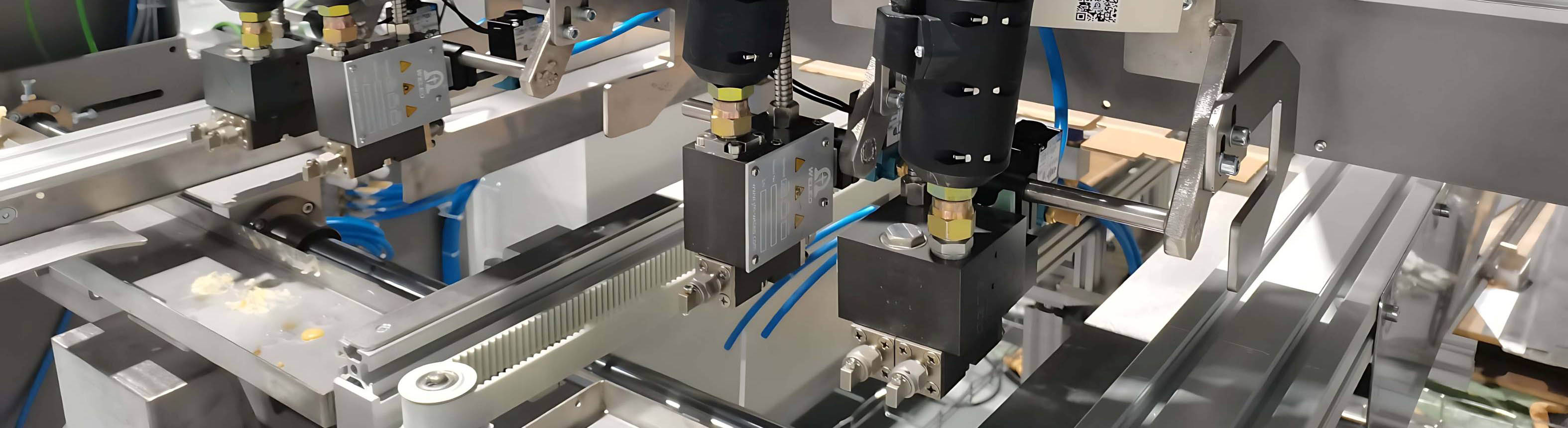
What Is a Piston Pump for Hot Melt?
In adhesive processing, the pump defines how material moves, how stable the output remains, and how reliably the system performs under pressure. Among different pump types, piston-based solutions are widely used when high output force and strong delivery capability are required. Understanding what is piston pump adhesive helps explain why this technology is still essential in many hot melt applications.
A piston pump is a positive displacement device that uses a reciprocating motion to push adhesive forward. Instead of continuous rotation like a gear pump, it relies on a back-and-forth movement inside a cylinder to draw in and discharge material. This design makes it particularly suitable for handling medium to high viscosity adhesives in demanding environments.
Table of Contents
How a piston pump operates in adhesive systems
A piston pump works through a simple but effective cycle. When the piston retracts, it creates a vacuum that pulls adhesive into the chamber. When it moves forward, it pushes the adhesive out toward the outlet.
This repeated motion forms the basis of a piston pump glue system, delivering adhesive in controlled volumes with each cycle. The output is directly influenced by stroke length and operating frequency, allowing adjustments based on production needs.
In a hot melt piston pump system, heating elements are integrated to maintain adhesive in a molten state, ensuring smooth flow and preventing solidification inside the pump.
Key characteristics of piston pump technology
Piston pumps offer several advantages that make them suitable for specific adhesive processes.
High pressure capability
Piston pumps can generate strong output pressure, making them effective for long-distance delivery or applications requiring forceful adhesive application.
Adaptability to viscosity
These pumps handle a wide range of adhesive viscosities, especially thicker materials that require more force to move through the system.
Robust mechanical structure
The simple mechanical design provides durability in continuous operation, which is important in industrial production environments.
Because of these characteristics, piston pumps are commonly used in various adhesive pump application scenarios where stability under load is critical.
Types of piston pump systems
Different configurations exist depending on the driving mechanism and application requirements.
| Pump Type | Drive Method | Application |
|---|---|---|
| Manual piston pump | Mechanical | Low-volume operations |
| Hydraulic piston pump | Fluid pressure | Heavy-duty applications |
| Pneumatic piston pump | Air pressure | Industrial production lines |
A pneumatic piston pump system is widely used in manufacturing due to its reliability and ease of integration with existing air supply systems.
Advantages in hot melt adhesive processing
In hot melt systems, piston pumps provide several practical benefits.
They deliver strong and stable output even when adhesive viscosity changes. They are less sensitive to pressure fluctuations compared to some other pump types. Their design also supports continuous operation in demanding production environments.
Industry data suggests that piston-based systems can maintain consistent output in high-load conditions, helping reduce flow interruptions and improving overall process reliability.
Limitations to consider
While piston pumps are effective, they are not ideal for every application.
The reciprocating motion can create slight pulsation in flow, which may affect precision in applications requiring extremely uniform output. In such cases, additional control mechanisms or alternative pump types may be considered.
Maintenance is also important, as seals and moving components experience wear over time.
How WELEO optimizes piston pump systems
WELEO designs piston pump solutions that address real production challenges. Its systems integrate stable heating control, efficient flow paths, and reliable pressure regulation to ensure consistent adhesive delivery.
By optimizing internal structure and improving thermal management, WELEO reduces the risk of adhesive degradation and flow instability. This results in better performance across different production conditions.
The company’s approach focuses on balancing power and control, ensuring that piston pump systems deliver both strength and consistency.
Applications across industries
Piston pump systems are used in a wide range of industries where adhesive performance is critical.
They are commonly found in packaging lines, woodworking processes, hygiene product manufacturing, and automotive component assembly. Their ability to handle varying adhesive properties makes them suitable for diverse production requirements.
Conclusion
A piston pump for hot melt is a powerful and reliable solution for adhesive delivery. Its reciprocating mechanism allows it to handle demanding applications where pressure and durability are essential.
Understanding how a piston pump works and where it performs best helps manufacturers select the right system for their needs. WELEO provides piston pump solutions designed to deliver stable performance, supporting efficient and consistent adhesive application in modern production environments.