





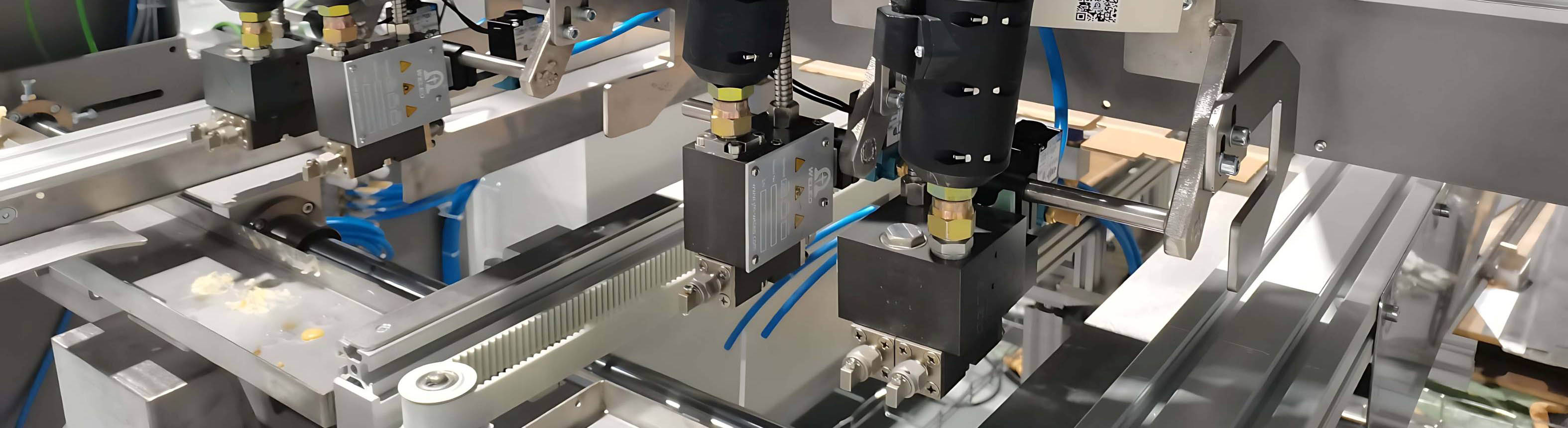
What Causes Uneven Glue Spraying?
Uneven spray patterns are a visible symptom of deeper process imbalance. Operators may see patchy coverage, overspray at the edges, or gaps in the middle, yet the root cause is rarely a single component. In high-speed lines, small deviations multiply quickly, turning a minor variation into a consistent defect. Industry surveys in 2024 show that coating irregularities can account for more than 20 percent of bonding-related quality issues in automated packaging and assembly.
Table of Contents
A quick look at how spray application behaves
Spray systems atomize adhesive into fine droplets and project them onto a surface in a defined pattern. Uniformity depends on droplet size, velocity, and distribution. When any of these factors drift, the pattern becomes inconsistent. This is why an uneven glue spray problem often appears suddenly even when settings have not changed.
Process studies indicate that droplet size variation above 10 percent can already create visible coating defects, especially on lightweight materials and high-speed conveyors.
Primary causes behind uneven spraying
Pressure fluctuation in the system
Spray formation relies on stable pressure. If the pressure fluctuates, the droplet size and spray angle change. This leads to inconsistent coverage across the target surface.
In many cases, unstable air supply or pump output creates irregular spray pulses. These pulses may not be visible at low speed but become critical in fast production.
Temperature inconsistency
Hot melt adhesives depend on controlled temperature to maintain proper viscosity. When temperature rises, adhesive becomes thinner and sprays wider. When it drops, the spray narrows or becomes intermittent.
Research data shows that a deviation of just 5 degrees Celsius can change spray width by more than 15 percent, making temperature one of the most sensitive variables in hot melt spray issues.
Nozzle condition and design
The nozzle defines the spray pattern. Wear, contamination, or improper design can distort the spray angle and droplet distribution.
A partially blocked nozzle often produces uneven edges or irregular flow lines. Over time, residue buildup reduces precision and affects overall system performance.
Adhesive quality and contamination
Inconsistent adhesive quality can also lead to spray instability. Contaminants or degraded material change flow behavior and atomization characteristics.
Manufacturing data suggests that contamination-related defects contribute to nearly 30 percent of spray inconsistencies in industrial lines.
System misalignment
Incorrect positioning of the spray head relative to the product surface can cause uneven coverage. Distance, angle, and movement synchronization all influence the final result.
Even a small misalignment can create uneven coating, especially in precision applications.
Common signs of spray inconsistency
| Observation | Likely Cause | Production Impact |
|---|---|---|
| Uneven coating thickness | Pressure or temperature variation | Weak bonding areas |
| Overspray on edges | Excess pressure or wide spray angle | Material waste |
| Gaps in spray pattern | Nozzle blockage or low pressure | Incomplete bonding |
| Irregular spray shape | Worn nozzle or misalignment | Poor product appearance |
Effective ways to improve spray uniformity
Stabilize pressure and flow
Consistent pressure is essential for uniform spray formation. Advanced systems use regulated supply and precise pump control to maintain steady output.
This is a key part of improving adhesive spray system control.
Maintain precise temperature control
Ensuring uniform heating across the tank, hose, and nozzle keeps adhesive viscosity stable. This directly affects spray consistency and pattern accuracy.
Select the right nozzle configuration
Choosing the correct nozzle type for the application improves spray distribution. Regular inspection and timely replacement prevent performance degradation.
Implement regular cleaning routines
Cleaning removes residue that can distort spray patterns. A structured cleaning schedule helps maintain consistent performance and reduces unexpected downtime.
Optimize system alignment
Correct positioning of spray heads ensures even coverage. Calibration should be part of routine maintenance to maintain alignment accuracy.
WELEO’s approach to spray consistency
WELEO designs adhesive systems with a focus on stable spray performance. Its solutions integrate precise pressure control, optimized heating systems, and advanced nozzle design to deliver consistent spray patterns.
By combining reliable hardware with intelligent control, WELEO helps manufacturers achieve a dependable glue spray consistency solution. The system architecture minimizes variation and supports stable operation across different production speeds and materials.
Why spray consistency matters
Uniform spray application improves bonding reliability and reduces adhesive waste. It also enhances product appearance, which is critical in industries such as packaging and consumer goods.
A 2024 efficiency report indicates that improving spray consistency can reduce adhesive consumption by up to 12 percent while lowering defect rates significantly.
Conclusion
Uneven glue spraying is typically the result of combined factors, including pressure instability, temperature variation, nozzle condition, and system alignment. Addressing these areas systematically leads to more consistent spray performance.
With the right equipment design and process control, stable spray patterns become achievable. WELEO provides solutions that help manufacturers maintain uniform adhesive application and improve overall production efficiency.