





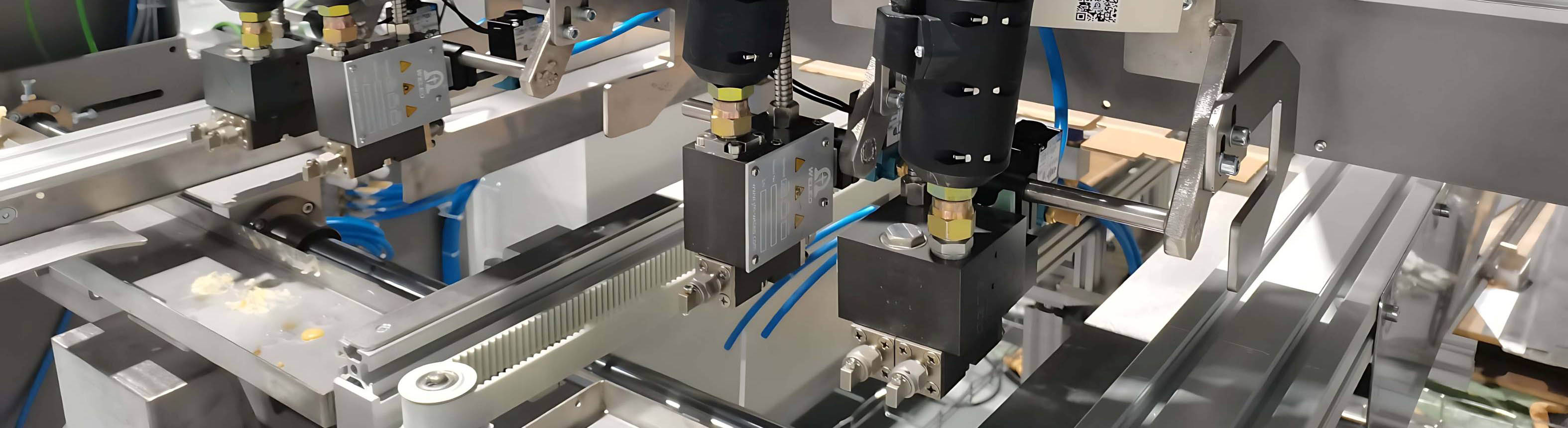
How to Control Glue Amount Accurately?
Precise glue output is not just a setting on the screen. It is the result of stable pressure, controlled temperature, matched pump design, clean flow channels, and reliable response from the applicator. When one of these variables drifts, the glue bead becomes heavier, lighter, wider, or broken, and the result is usually higher material cost, weaker bonding, and more rework on the line. Recent manufacturing reporting also notes that companies are turning to robotic and automated dispensing mainly to improve throughput, reduce waste, and raise quality consistency.
Many production teams ask how to control glue volume when the issue appears to come and go. In reality, glue amount errors often build up slowly. A small temperature swing changes viscosity. A worn valve changes response time. A pressure pulse from the supply side changes shot size. Over time, these small deviations create visible variation in coating weight, bead shape, and adhesive consumption. Technical guidance from 3M shows that even a 10 degree Celsius change can double or halve reaction rate, which helps explain why temperature drift quickly affects adhesive behavior on the line.
Table of Contents
Where glue amount errors usually begin
The first source is pump behavior. A dispensing system can only be as accurate as the material delivery section behind it. Positive displacement technology is valued in industrial dispensing because it supports repeatable ratio and volume output and can maintain a constant pressure or flow rate. That matters in fast lines where even small inconsistency repeats thousands of times per shift.
The second source is temperature management. In hot melt processing, adhesive viscosity is closely tied to heat stability. If the tank, hose, and gun do not stay within a tight range, the same valve opening time can deliver different glue amounts at different moments. For this reason, strong hot melt glue control depends on full-path heating rather than tank heating alone. Technical adhesive literature also notes that flow and wetting behavior are strongly influenced by viscosity at application.
The third source is the valve and nozzle. Assembly industry reporting highlights that better dispensing components can improve shot-to-shot repeatability and reduce waste, while contamination and poor component choice can do the opposite. In practical terms, a partially blocked nozzle, internal wear, or unstable trigger response can make glue amount look like a pump problem even when the root cause is further downstream.
A quick diagnostic view
| Process symptom | Most likely cause | Production effect |
|---|---|---|
| Bead becomes wider at the same speed | Viscosity drop from excess heat | Higher adhesive use |
| Shot size changes between cycles | Pressure instability or valve wear | Variable bond strength |
| Tail stringing after dispense | Temperature or cutoff issue | Dirty appearance and cleanup |
| Random skips in the bead | Nozzle blockage or trapped air | Missed bonding area |
| Heavy glue at startup | Overheating or delayed response | Scrap during line start |
Five practical ways to improve glue accuracy
1. Match the pump to the process
Low-volume pattern work and high-volume continuous coating do not need the same delivery method. Gear pump systems are often preferred where repeatable metering matters most, while piston systems are useful for other operating demands. The key is to size the pump by adhesive viscosity, target output, line speed, and required control accuracy rather than by general capacity alone. A well-matched precision adhesive dispensing system reduces output deviation before the glue ever reaches the applicator.
2. Control the whole thermal path
Accurate output requires one thermal logic from melter to hose to applicator. When only one zone is controlled well, glue amount can still drift at the nozzle. This is especially true in high-speed packaging, product assembly, and label lines, where a small viscosity change shows up immediately in bead weight and cutoff quality. A stable heat profile gives the operator a fixed process window and makes settings easier to repeat shift after shift.
3. Stabilize pressure before chasing software settings
Many teams try to correct glue amount by changing time settings first. That is usually the wrong order. If material pressure is fluctuating, the controller is compensating for an unstable supply. Pressure stability should be checked before recipe tuning. Where the supply section can maintain constant pressure or flow, the line gets better repeatability and less tuning drift over time.
4. Reduce waste at changeover points
Industry reporting on dispensing waste shows that changeover is a major source of adhesive loss, and over-deposit in some applications can cut waste by 50 percent or more when eliminated. This is an important reminder that glue accuracy is not only about the running state. Startup, product switching, and shutdown also shape total adhesive cost. A good automated glue application system should help the line transition cleanly, not only run fast in the middle of a batch.
5. Use measurable maintenance standards
Accurate dispensing cannot be sustained by visual inspection alone. Nozzle cleaning cycles, hose inspection intervals, valve response checks, and temperature sensor verification should all be standardized. Once these points are measured and logged, glue amount variation becomes easier to trace and correct. This is where an accurate glue dispensing solution becomes a management tool as much as an equipment choice.
Why this matters for cost and product quality
Glue is often a small part of total unit cost, but glue error creates a much bigger cost chain. Too little adhesive leads to weak sealing, poor bonding, and field complaints. Too much adhesive raises consumption, contaminates the product surface, and slows cleaning and maintenance. Manufacturing coverage from Assembly magazine notes that automated dispensing helps improve efficiency, precision, and safety while minimizing material waste. In high-volume production, even a 10 percent reduction in over-deposit can create rapid payback.
How WELEO supports accurate glue control
WELEO focuses on adhesive equipment that addresses glue amount accuracy from the source rather than from surface-level adjustment alone. Its product range covers piston pump units, high-precision gear pump units, quantitative spraying systems, PUR reactive hot melt equipment, and cold gluing systems, which gives manufacturers more flexibility to match the dispensing method to the real process. The company’s equipment is already applied across beverage packaging, food packaging, paper products, atomizer assembly, new energy, non-woven materials, labels, and automation lines.
From the product information visible on the site, WELEO highlights stable pressure design, intelligent control, multiple hose connection capability, and Teflon-coated melting chambers that help reduce carbonization and simplify cleaning. Its piston pump melter series is also specified for working viscosities from 500 to 50000 cps and operating temperatures from 38 to 210 degrees Celsius, showing that the company is building around real process ranges rather than generic descriptions. For manufacturers comparing options, this matters because glue accuracy improves when the system is engineered for viscosity range, hose load, pressure control, and maintenance practicality together.
What a better process looks like
A controlled dispensing line usually shares the same characteristics. The pump output is repeatable. Temperature is steady across all heated zones. Pressure does not pulse during demand changes. The nozzle closes cleanly. Startup scrap is limited. Operators are not forced to keep correcting settings every few hours. When those conditions are present, glue amount becomes predictable, and the production team gains a more stable quality window.
Controlling glue amount accurately is therefore less about one adjustment and more about building a complete process around stable delivery. For manufacturers that need cleaner beads, lower adhesive waste, and more dependable bonding results, the right equipment architecture makes that improvement achievable. WELEO’s application-focused portfolio gives production teams a practical route to better dispensing precision and more consistent output on modern adhesive lines.