





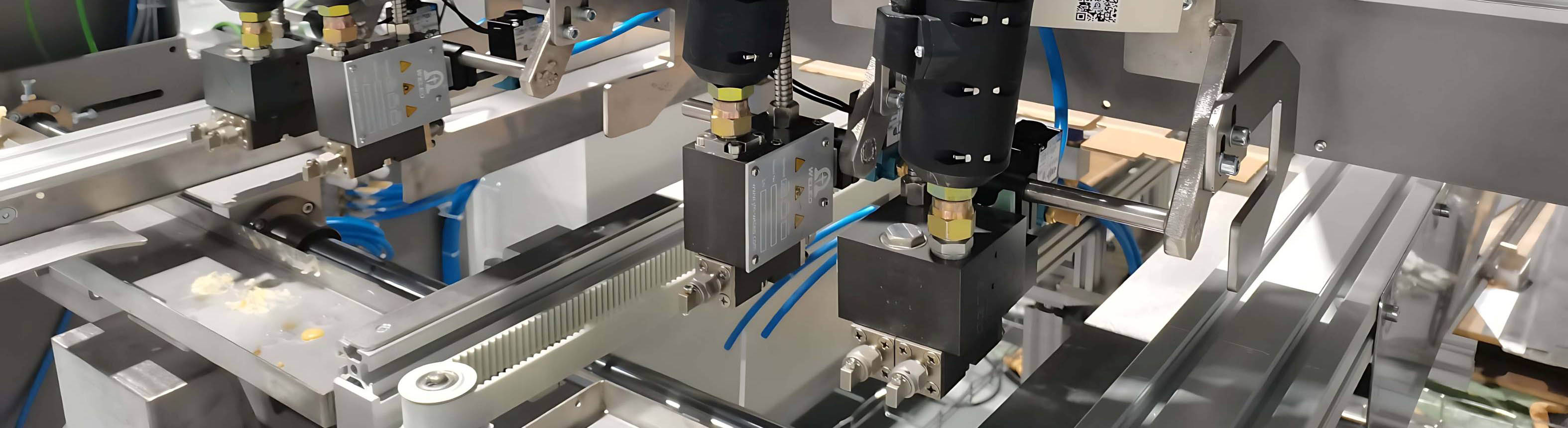
Why Do Adhesive Systems Fail in High Speed Lines?
High-speed production puts much heavier pressure on adhesive equipment than ordinary manual or semi-automatic work. When the line speed increases, the glue system must melt faster, deliver more consistently, respond more quickly, and apply adhesive with repeatable accuracy. Once heating, flow, pressure, nozzle control, or machine matching becomes unstable, failure appears very quickly.
WELEO focuses on Hot Melt Adhesive Supply Units, PUR Reactive Hot Melt Adhesive Units, cold gluing systems, Heated Hoses, applicators, nozzles, and automatic dispensing solutions. These systems are used in packaging, paper products, labels, non-woven materials, furniture, electronics, new energy, and automated assembly fields, where stable adhesive output is closely connected with production efficiency.
Table of Contents
1. The Melting Capacity Cannot Keep Up With Line Speed
One common reason for failure is insufficient melting capacity. A fast production line adhesive process needs the glue tank or PUR melting unit to supply molten adhesive continuously. When production speed rises but the melting rate stays the same, the system may begin to deliver partly melted adhesive or unstable flow.
This can cause skipped glue lines, weak bonding, pump strain, and frequent operator adjustments. WELEO’s hot melt adhesive system explanation shows that a complete system must melt, transport, control, and apply adhesive as one continuous process. When one step falls behind, the whole line becomes unstable.
2. Viscosity Changes During Continuous Running
Hot melt adhesive viscosity is highly sensitive to temperature. ASTM D3236 is a standard method for measuring apparent viscosity of hot melt adhesives and coating materials, with testing conditions covering materials up to 200,000 mPa·s at temperatures up to 175°C. This shows why viscosity is not a small detail in production control.
During high speed adhesive application, unstable viscosity can create several problems:
Adhesive becomes too thick and flow becomes delayed.
Glue lines become uneven at the nozzle.
Pump pressure increases and causes mechanical stress.
Bonding strength becomes inconsistent across the same batch.
Operators keep changing settings without solving the root cause.
For high-speed lines, the tank, hose, gun, and nozzle must maintain stable temperature together. A good temperature setting at the tank is not enough if the hose loses heat before the adhesive reaches the applicator.
3. Pump Output Is Not Accurate Enough
High-speed bonding requires accurate and repeatable glue volume. When pump output fluctuates, the adhesive amount changes with line speed. Too much glue creates overflow, stringing, slow cooling, and waste. Too little glue causes poor contact and weak bonding.
WELEO notes that glue amount accuracy should be managed from the equipment source, using suitable piston pump units, gear pump units, quantitative spraying systems, PUR reactive hot melt equipment, and cold gluing systems according to the real process.
| Failure Point | What Happens On The Line | Better Control Method |
|---|---|---|
| Low melting rate | Adhesive supply becomes unstable | Match tank capacity with glue consumption |
| Poor viscosity control | Glue line changes during production | Keep full-path temperature stable |
| Weak pump precision | Glue amount varies at high speed | Select suitable metering method |
| Wrong nozzle size | Spraying or bead shape becomes uneven | Match nozzle pattern with output demand |
| Slow signal response | Glue position shifts | Improve control timing and automation link |
4. Nozzles And Applicators Cannot Respond Fast Enough
Many glue application high speed issues come from the applicator. In high-speed packaging, labeling, assembly, or non-woven processes, the nozzle must open and close quickly. When response time is too slow, glue may appear in the wrong position. This leads to tailing, stringing, missing spots, or product contamination.
Nozzle design, air pressure, valve response, adhesive viscosity, and control signal timing must work together. Simply increasing glue temperature may make flow easier, but it can also increase oxidation risk or create stringing if the applicator is not suitable.
5. The System Was Not Selected For High-Speed Production
An adhesive system for high speed line should be selected according to adhesive type, line speed, glue consumption, application width, bonding pattern, open time, substrate material, and automation control method. Failure often happens when a machine is used beyond its suitable working range.
WELEO provides different system options, including hot melt supply units, PUR reactive systems, cold gluing systems, heated hoses, hot melt guns, slot die applicators, bead applicators, and nozzles. This makes it easier to match the adhesive equipment with the actual process instead of forcing one standard system into every production line.
6. Maintenance Is Too Reactive
High-speed lines leave less time for minor problems to develop slowly. A dirty filter, worn seal, blocked nozzle, damaged hose connector, or unstable sensor can quickly turn into line stoppage. Strong industrial glue system performance depends on preventive checks, not only emergency repairs.
Daily inspection should include glue level, tank cleanliness, filter pressure, pump sound, hose temperature, nozzle condition, air supply, and signal response. These checks are simple, but they help detect problems before they create a full production failure.
Conclusion
Adhesive systems fail in high-speed lines because melting, viscosity control, pump output, nozzle response, system matching, and maintenance are not stable enough for continuous production. The solution is not only to use stronger glue. The key is to build a matched adhesive application system with stable heating, accurate metering, fast response, clean delivery, and practical maintenance. WELEO helps manufacturers improve system reliability by providing adhesive equipment solutions that match real production speed, adhesive behavior, and application requirements.