





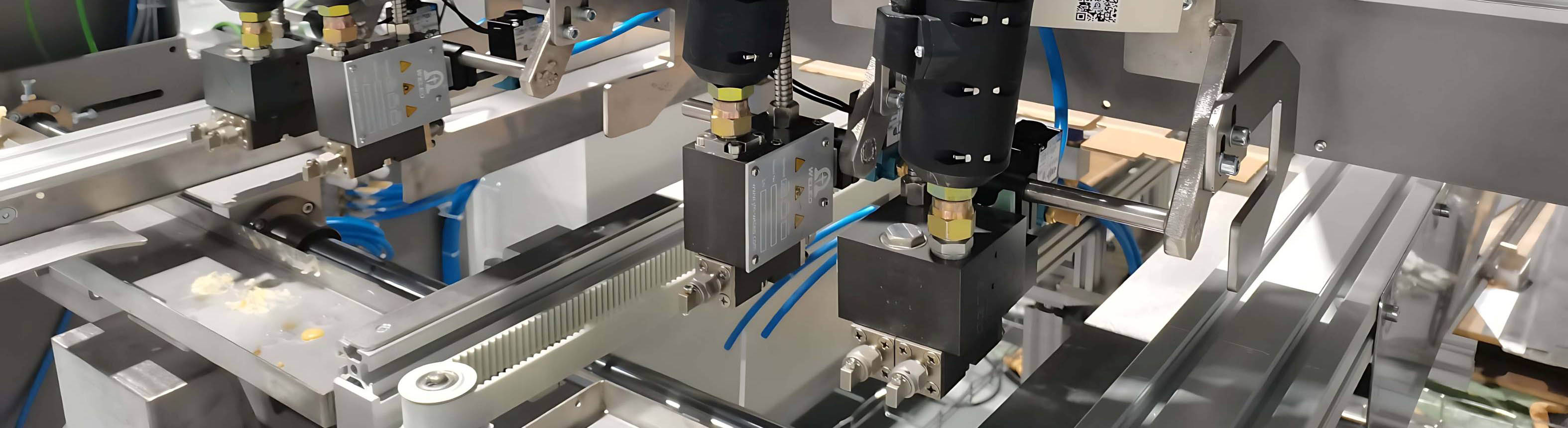
How To Choose Adhesive Dispensing Equipment For Nonwoven Products?
Nonwoven bonding requires controlled adhesive coverage without blocking softness, breathability, elasticity, or liquid-management performance. Equipment selection should reflect substrate weight, web speed, stretch direction, bond location, target coat weight, adhesive viscosity, and the finished product's required feel and strength.
| Nonwoven process need | Equipment priority |
|---|---|
| Light substrate | Low and repeatable adhesive weight |
| Elastic attachment | Accurate placement with flexible pattern |
| Wide web lamination | Uniform cross-web distribution |
| High-speed converting | Fast response and speed compensation |
| Several product widths | Adjustable heads or stored recipes |
| Sensitive surface | Limited overspray and heat exposure |
Table of Contents
Define the Function of Each Bond
A construction bond between layers has different requirements from elastic attachment, positioning, or edge sealing. Mark the useful bond zones, uncoated areas, pattern width, and acceptable penetration before choosing a nozzle.
The approved adhesive weight should balance holding strength with softness. Excessive application may stiffen the product, block pores, create visible penetration, or interfere with elastic movement.
Match the Adhesive With the Web
Nonwoven materials vary in fiber composition, basis weight, surface treatment, porosity, and heat sensitivity. The adhesive must wet the fibers without soaking through excessively or cooling before contact is completed.
Provide viscosity across the working temperature range, open time, recommended coat weight, and thermal limits. nonwoven adhesive dispensing equipment must keep the material stable from the melter through the hose and application head.
Select the Application Pattern
Spiral, swirl, omega, elastic, and other spray patterns distribute adhesive differently. Wide construction bonds may need uniform area coverage, while elastic strands require narrow and controlled placement.
A hot melt spray application system should allow material flow, air settings, nozzle height, and web speed to be adjusted independently. Increasing atomizing air alone may widen the pattern but reduce deposit density or increase airborne overspray.
Size Dosing for the Complete Speed Range
Calculate flow from coat weight, application width, web speed, and the number of active heads. Include acceleration and maximum production speed rather than sizing from one normal setting.
A controlled gear pump may be used when flow must follow line speed closely. Pump displacement should keep the drive within a stable range for both narrow products and full-width operation.
Protect Pattern Position
For glue system for nonwoven production integration, encoder signals can link pump output and pattern timing with web movement. Trigger control should prevent adhesive release during web breaks, missing material, or line stops.
Nozzle distance should remain stable as web tension and speed change. Excessive flutter may shift the spray or alter local coat weight even when pump delivery remains accurate.
Verify Cross-Web Uniformity
Collect samples from the left, center, and right sides of a wide pattern. Compare total coat weight, local distribution, bond strength, softness, and visible penetration at low, normal, and maximum speed.
Filters, nozzles, Heated Hoses, and air passages should be checked when one zone drifts. WELEO configures dosing pumps, heated paths, elastic and swirl-style application modules, controls, and mounting around actual nonwoven samples and production data. This supports repeatable coverage while protecting material feel and controlling adhesive use.