





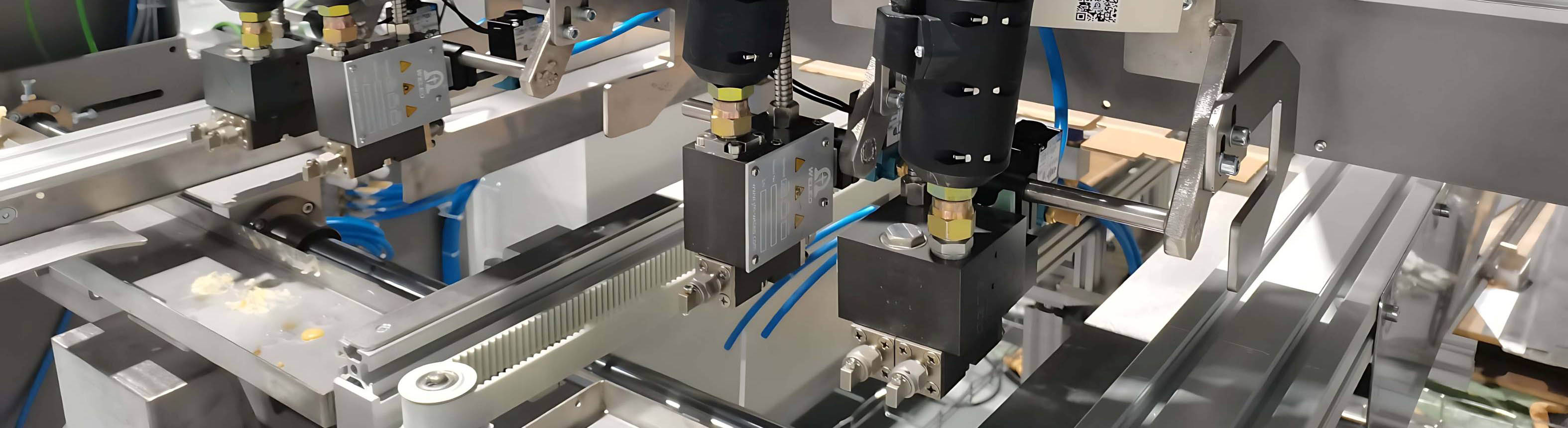
What Is A High Speed Adhesive Dispensing System?
A high-speed system applies the required adhesive quantity at the correct position while products move through short, repeated cycles. Performance depends on melt or supply capacity, pump response, valve switching, sensor accuracy, line-speed tracking, and the ability to recover between applications.
Table of Contents
Speed Is More Than Products Per Minute
Two lines running at the same production rate can create different demands. One may use a single short bead, while another opens several guns simultaneously or applies a broad spray pattern. Deposit weight, cycle time, active channels, and duty ratio must be calculated together.
| Speed-related factor | Engineering question |
|---|---|
| Cycle time | How much time is available for each deposit? |
| Peak flow | How much adhesive is required while guns are open? |
| Duty cycle | How long do applicators remain active? |
| Line acceleration | Must output change with conveyor speed? |
| Product spacing | Can the valve close fully between products? |
| Number of lanes | Which outlets operate simultaneously? |
Supply Capacity Must Cover Peak Flow
Average hourly adhesive use may appear low even when short application windows require high instantaneous flow. The pump, manifold, hoses, filters, and applicators must deliver this peak without excessive pressure loss.
For hot melt, heater power and melt rate must support continuous demand after material refilling. A fast production glue system that loses temperature during peak output will show rising viscosity, changing bead weight, and delayed valve response.
Applicator Response Determines Placement
The time between an electrical trigger and adhesive reaching the substrate includes controller processing, solenoid response, valve movement, and material flow. At high line speed, a small delay can shift the bead noticeably.
Gun close response is equally important. Slow cut-off creates tails, stringing, contamination, or glue between products. Mounting position and sensor distance should be established from measured response rather than assumed timing.
Link Dispensing With Product Movement
An encoder or reliable speed reference allows the high speed glue dispensing system to compensate as the conveyor accelerates. Distance-based pattern control maintains bead length more effectively than a fixed time command when speed varies.
Trigger position should be validated at minimum, normal, and maximum line speed. A timing value that works at one fixed speed may move the bead when the conveyor accelerates.
Stabilize Pressure and Viscosity
industrial adhesive speed alone does not guarantee consistent output. Temperature drift changes viscosity, while blocked filters and undersized hoses increase pressure loss. The result may be a correct trigger with an incorrect glue quantity.
Increasing pump pressure is not a reliable correction for every output problem. Heater condition, filter restriction, hose sizing, nozzle opening, and simultaneous applicator demand should be checked first.
Verify Performance at the Operating Limits
Acceptance tests should run at low, normal, and maximum speed. Include acceleration, refill recovery, simultaneous channel operation, planned stops, and repeated short cycles.
Measure:
Glue weight per product
Start and stop position
Bead or spray dimensions
Temperature and pressure recovery
Missed or incomplete applications
Stringing and cut-off quality
WELEO configures each fast adhesive dispensing solution around peak flow, cycle time, adhesive behavior, applicator response, and line signals. A reliable high speed glue system must maintain deposit weight and position throughout the real speed range, not only during one steady demonstration condition.