





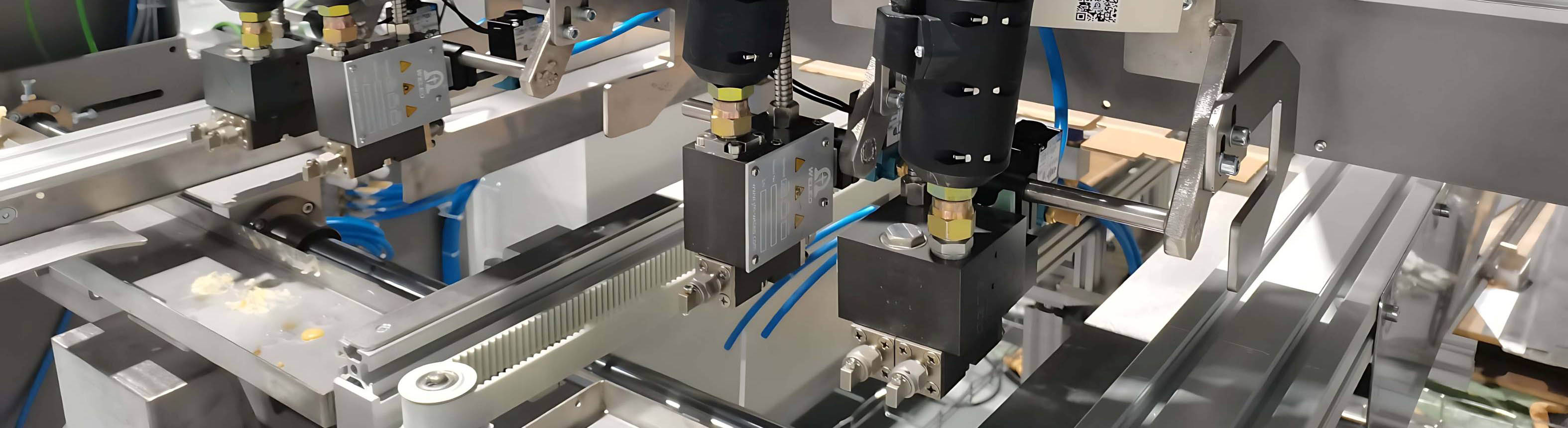
Latest Trends in Quantitative Spraying and Coating Systems
In today’s automated manufacturing world, precision adhesive application has evolved beyond simple spraying. Quantitative spraying and coating systems are now the standard for industries that require exact adhesive dosage, uniform coverage, and zero waste. These systems combine digital control, intelligent sensors, and precision gear pumps to ensure every drop of adhesive is applied accurately.
This article explores the latest innovations and trends in quantitative spraying and coating technology, and how they are transforming production efficiency in packaging, automotive, nonwoven, and electronics manufacturing.
Table of Contents
What Is a Quantitative Spraying and Coating System
A quantitative spraying and coating system is an adhesive delivery solution designed to apply a measured volume of glue per cycle or per unit area. Unlike conventional spray guns that rely on manual timing or pressure fluctuation, these systems use closed-loop feedback control to regulate flow, temperature, and pressure simultaneously.
| Core Component | Function |
|---|---|
| Gear or Piston Pump | Provides consistent adhesive flow rate |
| Spray or Slot Head | Applies adhesive in defined volume and pattern |
| Temperature Controller | Maintains stable viscosity during operation |
| Flow Sensor | Monitors actual adhesive output in real time |
| PLC or Touchscreen Panel | Adjusts parameters for accurate dosing |
By controlling all parameters digitally, these systems ensure precision coating at high production speeds.
How Quantitative Systems Work
Melting and Pumping The adhesive (usually EVA, PUR, or polyolefin hot melt) is melted in a controlled tank. A gear or piston pump meters the flow precisely based on the pre-set output volume.
Real-Time Monitoring Flow sensors and temperature probes continuously measure adhesive delivery and viscosity. The PLC compares this data with target parameters and makes instant corrections.
Spraying or Coating The adhesive passes through heated Hoses to the spray or slot head, which applies it evenly onto the substrate. The coating width, pattern, and thickness are all programmable.
Feedback Adjustment If line speed or substrate conditions change, the system automatically adjusts output flow, maintaining perfect coating balance throughout production.
Key Trends Driving Modern Quantitative Spraying Systems
1. Digital Precision Control
Modern systems integrate servo motors and smart sensors to regulate every part of the adhesive path. This enables repeatable dosing accuracy within ±1%, ensuring clean and consistent application even at high speeds.
2. Integration with Smart Automation
Quantitative spraying systems are increasingly connected to PLC and MES platforms, allowing real-time data collection, automatic recipe switching, and remote monitoring. This integration supports smart factory management and predictive maintenance.
3. Multi-Pattern Application Capability
Manufacturers now demand flexible systems that can switch between line, dot, spiral, or film coating without hardware changes. Advanced software controls allow instant pattern adjustments directly from the operator interface.
4. Energy-Efficient Heating and Pumping
The latest models feature zone-controlled heaters and energy recovery systems that reduce power consumption by up to 20%. Precise temperature management also prevents adhesive degradation, extending material shelf life.
5. Eco-Friendly Adhesive Compatibility
As sustainable production grows, quantitative systems are optimized for bio-based, low-VOC, and recyclable adhesives. Stable temperature and flow control ensure these eco-friendly materials perform reliably across production lines.
Applications Across Industries
Quantitative spraying and coating systems are widely used in industries that require consistent adhesive performance:
Packaging: Precision gluing for cartons, trays, and beverage boxes.
Automotive: Controlled adhesive dosing for sound insulation, seating, and interior assembly.
Nonwoven Fabrics: Uniform coating for hygiene products and Filters.
Electronics: Micro-volume adhesive dispensing for PCBs and display assembly.
Furniture and Laminating: Smooth and uniform coating for veneers and panels.
Their adaptability across multiple applications makes them a vital part of advanced manufacturing automation.
Advantages Over Conventional Systems
| Feature | Quantitative System | Conventional Spray System |
|---|---|---|
| Flow Control | Digital feedback loop | Manual or pneumatic |
| Accuracy | ±1% dosing precision | Varies with pressure |
| Pattern Switching | Automatic via software | Requires manual setup |
| Energy Efficiency | High (multi-zone heating) | Moderate |
| Maintenance | Predictive and automatic | Periodic manual checks |
| Waste Reduction | Minimal | Higher material loss |
Quantitative systems redefine efficiency by combining precision engineering with intelligent control, ensuring optimal adhesive use and superior production quality.
Maintenance and Operation Insights
To maintain top performance:
Calibrate flow sensors regularly for accuracy.
Keep adhesive temperature within the specified tolerance range.
Inspect Nozzle openings to prevent residue buildup.
Use compatible adhesives to maintain consistent viscosity.
Schedule preventive maintenance to avoid pump wear or flow deviation.
These practices ensure long-term reliability and minimal downtime in automated production.
Future Outlook
The next generation of quantitative spraying and coating systems will continue to emphasize intelligence, sustainability, and miniaturization. Integration with AI algorithms will allow predictive adjustments in real time, while modular designs will enable manufacturers to expand or reconfigure systems easily for different production needs.
Additionally, innovations in low-temperature hot melt adhesives and ultra-thin coating control will further enhance efficiency and environmental performance.
Conclusion
A quantitative spraying and coating system represents the future of adhesive application—combining accuracy, intelligence, and efficiency. By providing precise adhesive control, real-time monitoring, and integration with smart automation platforms, these systems dramatically improve material utilization and product consistency.
Previous:
Next: How Pellets Adhesives Filling Systems Improve Material Use?