





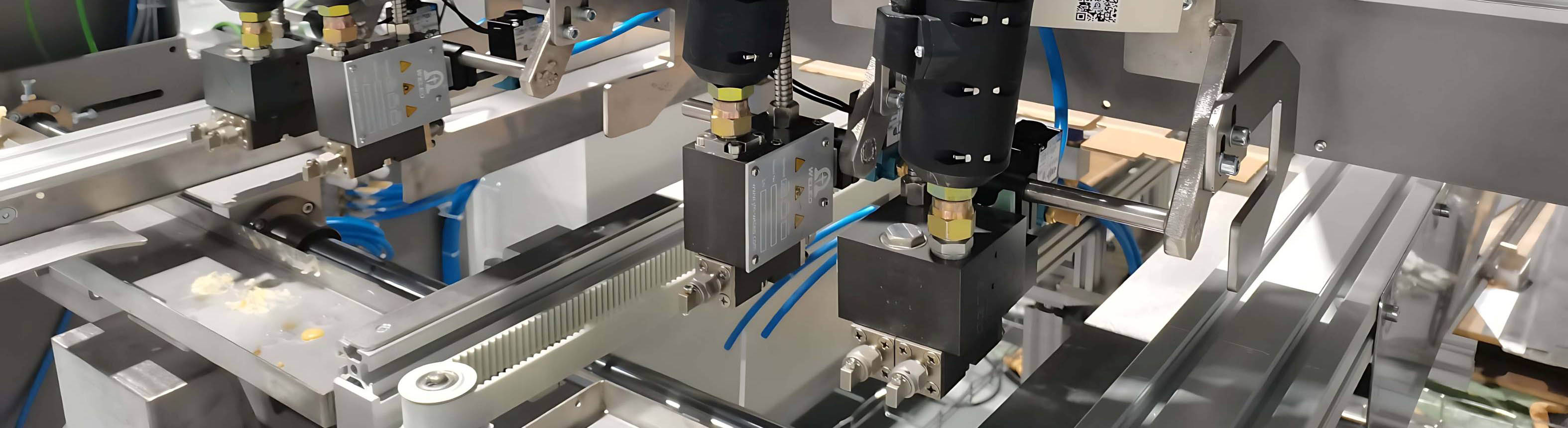
Choosing Between Mini Bead and Dot Dispensing Guns
In adhesive application systems, selecting the right type of dispensing gun is critical to achieving precision, efficiency, and product quality. Two of the most common options are mini bead guns and dot dispensing guns, both designed for hot melt or cold glue applications in packaging, labeling, electronics, and nonwoven production lines.
Although they share similar control principles, each type of gun is optimized for specific adhesive patterns and production speeds. Understanding their differences helps manufacturers select the most suitable solution for their needs.
Table of Contents
Overview of Bead and Dot Dispensing Guns
Both mini bead and dot dispensing guns operate through controlled adhesive flow and valve actuation. They receive pressurized adhesive from a melter or pump system and release it through precision Nozzles. The main distinction lies in the output pattern and application method.
| Type | Output Pattern | Typical Use |
|---|---|---|
| Mini Bead Gun | Continuous linear bead | Sealing, edge gluing, continuous bonding |
| Dot Dispensing Gun | Intermittent dot pattern | Labeling, point bonding, micro assembly |
While bead guns provide a steady adhesive line, dot guns release individual adhesive spots at controlled intervals.
How Mini Bead Dispensing Guns Work
Mini bead dispensing guns are designed to apply a continuous, narrow line of adhesive onto a substrate. They are commonly used in high-speed packaging and sealing operations, where consistent bonding strength is required across long surfaces.
Continuous Flow Control The gun connects to a hot melt melter or gear pump, maintaining steady pressure and adhesive temperature. The solenoid valve or trigger ensures uninterrupted adhesive output.
Nozzle Design and Precision The nozzle opening determines bead width, which can be adjusted to fit the product surface. High-speed valves allow for on/off switching when short gaps are needed between lines.
Consistent Bond Strength Continuous adhesive lines provide even bonding force, which is especially important for carton closing, tray sealing, and edge wrapping.
Advantages of Mini Bead Guns
Uniform Glue Lines: Produces smooth and consistent adhesive coverage.
Strong Sealing Performance: Ideal for packaging that requires tight closure.
Adaptable Width Control: Supports adjustable bead diameters from 0.3 mm to 2.0 mm.
Low Maintenance: Simple construction and easy nozzle replacement.
How Dot Dispensing Guns Work
Dot dispensing guns apply small, discrete dots of adhesive at programmed intervals. The gun opens and closes rapidly—often several times per second—controlled by a pneumatic or electronic valve. This technique reduces material use while maintaining effective bonding.
Timed Valve Activation A controller or PLC triggers the valve to open for a fraction of a second, releasing a single adhesive drop. The cycle repeats according to production speed and spacing requirements.
Precision Placement Each dot is precisely located, ensuring accurate adhesive placement on specific contact points such as labels, Filters, or assembly parts.
Energy and Material Efficiency Since dots cover less area than lines, they consume 20–40% less adhesive, reducing cost and weight without compromising strength.
Advantages of Dot Dispensing Guns
Excellent Material Savings: Applies adhesive only where needed.
Fast Switching Speed: Can operate at up to 500 cycles per minute.
Precise Spot Control: Suitable for delicate or small product areas.
Clean Production: Minimizes glue strings and overspray.
Key Differences Between Mini Bead and Dot Dispensing Guns
| Feature | Mini Bead Gun | Dot Dispensing Gun |
|---|---|---|
| Adhesive Pattern | Continuous line | Intermittent dots |
| Application Speed | Medium to high | Very high |
| Material Usage | Higher | Lower |
| Ideal for | Sealing, edge gluing | Labeling, spot bonding |
| Adhesive Type | Hot melt (EVA, PO) | Hot melt or cold glue |
| Automation Compatibility | High | Very high |
| Maintenance | Low | Moderate (due to high cycling rate) |
The choice between the two depends on pattern accuracy, production speed, and material requirements.
Applications in Industry
Packaging:
Mini bead guns are ideal for box sealing and tray gluing, where continuous lines ensure closure integrity.
Dot dispensing guns are perfect for label gluing or small carton bonding, reducing waste on repetitive tasks.
Electronics: Dot guns provide micro-scale adhesive control for circuit assembly or protective coatings.
Nonwoven Fabrics: Both systems can be used — bead guns for base layers, and dot guns for light bonding of upper materials.
Automotive Assembly: Mini bead guns deliver uniform adhesive lines for sealing gaskets and trims.
Bookbinding and Paper Converting: Dot guns ensure clean bonding with precise adhesive placement, avoiding paper deformation.
How to Choose the Right System
When selecting between mini bead and dot dispensing guns, manufacturers should evaluate:
Substrate Size and Shape: Continuous surfaces favor bead guns; small or spaced surfaces benefit from dots.
Adhesive Consumption Goals: Dot systems save material for light-duty bonding.
Speed and Automation Requirements: For high-speed or programmable lines, dot systems offer finer control.
Bond Strength Needs: Bead guns provide stronger, uniform adhesion for structural packaging.
Matching the gun type with adhesive characteristics and production needs ensures maximum efficiency and durability.
Conclusion
Both mini bead and dot dispensing guns provide essential adhesive control for industrial applications. Mini bead guns excel at continuous sealing and high-strength bonding, while dot dispensing guns offer superior precision and material savings for high-speed automation.
For professional adhesive dispensing solutions and equipment customization, Weleo offers a full range of bead and dot glue guns engineered for precision, reliability, and long-term performance across packaging, nonwoven, and electronics industries.